






I’m excited to share my recently published book chapter from Metrics, Mapping, and Modelling for Masterful Management in Higher Education (Emerald Press, 2025) entitled Explore options while modelling the organization’s group structure.
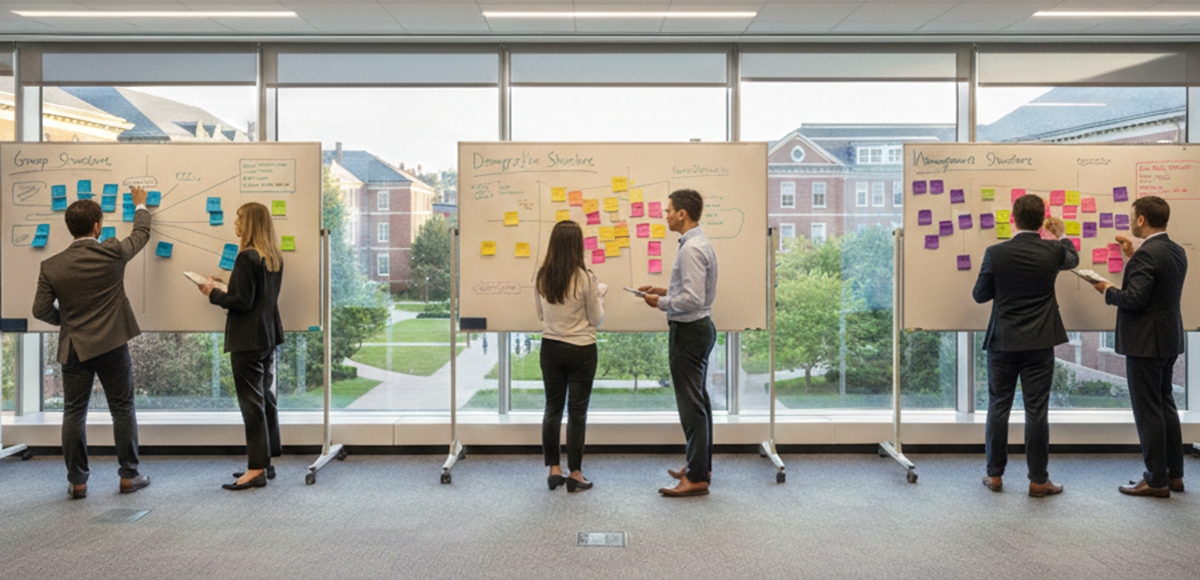
Chapter 9 zooms in on the “group logic” that makes a higher education institution run—its administrative units, committees, clubs and organizations, stakeholder and demographic groups, and even external peer/comparison groups. It shows readers how to model these structures in the Sentient Knowledge Map (SKM) using clear schemas, so roles, responsibilities, and scope of impact are visible—not assumed. Along the way, the chapter demonstrates how to propose and test alternative administrative and committee structures (especially using backward design), integrate units and committees into an institutional model, and track changes over time with a practical change-management tagging approach. Because higher education is a service enterprise, the chapter also emphasizes mapping who each group serves and how decisions and structures affect different populations. The result is a more transparent, discussable blueprint of how the institution is organized—one that supports stakeholder input before changes become permanent, and lets leaders learn from other institutions through shared resources in the SKM library.
Many of the book’s chapters have a companion video which can be viewed for free on the Higher Education Leadership Learning Online Community web site. Visit the site to see the complete and evolving list.
If you’re involved in higher-ed leadership, strategy, assessment, or institutional research, I’d love for you to take a look at the chapter and add your comments below. If you would like assistance implementing any of the ideas addressed, please compete a consultation request form – the first hour is free for any institution.
Discover more from G Squared Higher Ed Consulting
Subscribe to get the latest posts sent to your email.